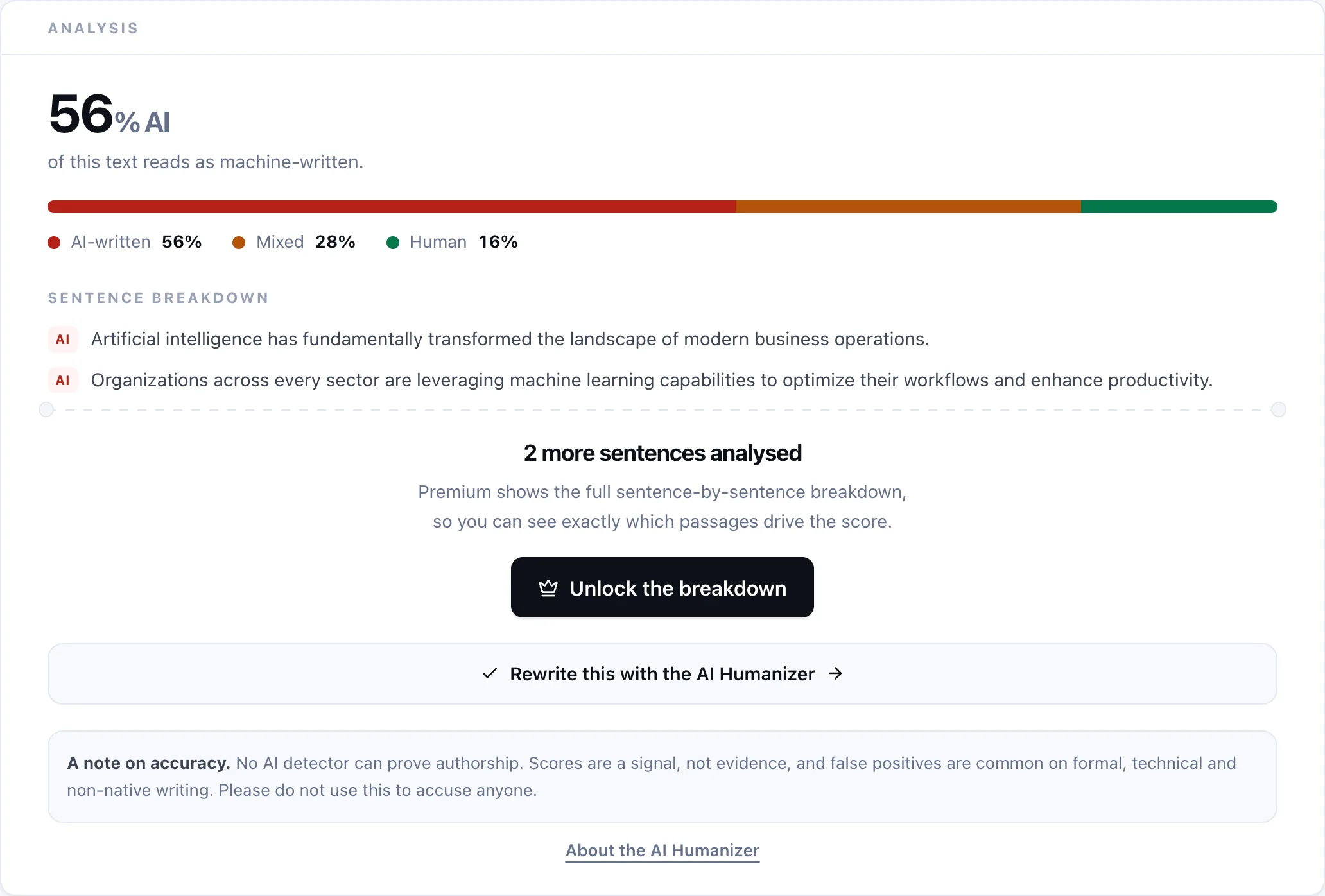
An AI content detector estimates how much of a passage reads as machine-written. This one returns three percentages that always add to 100 — AI, mixed and human — plus a sentence-by-sentence breakdown, so you can see which lines drive the score instead of trusting a single opaque number.
- 3
- Percentages, summing to 100
- 40
- Word minimum
- 12
- Languages
- $0
- To start
The basics
What is an AI content detector?
It is a statistical classifier. It reads your text, measures properties that tend to differ between human and machine writing, and reports how machine-like the passage looks. It does not — and cannot — know who actually wrote it.
That distinction is the whole ballgame, and most detectors bury it. A detector produces evidence about text, never proof about a person. Everything below follows from that.
Getting started
How to check text for AI
Paste at least 40 words
The minimum is deliberate. Detection is statistical, and short passages do not contain enough signal for any honest judgement. We decline rather than return a number we cannot stand behind.
Run the analysis
You get the percentages immediately, and the sentence breakdown beneath them.
Read the sentences, not just the number
A 60% score means very different things depending on whether it comes from six evenly-suspicious sentences or two heavily flagged ones.
Interpretation
What the three numbers mean
| Means | Reasonable reading | |
|---|---|---|
| AI | Reads as machine-generated | Uniform rhythm, stock transitions, low surprise |
| Mixed | Both signatures present | Often AI text a person edited, or human text a tool tidied |
| Human | Reads as person-written | Varied rhythm, idiom, the occasional imperfection |
Mixed is the most informative category and the most ignored. Most real-world writing in 2026 is collaborative — drafted by a person and tidied by a tool, or vice versa. A high mixed percentage usually means exactly that, and it is not evidence of anything improper.
Mechanics
How AI detection actually works
Predictability
Language models pick high-probability words. Detectors measure how surprising your word choices are given everything before them — text where each next word is easy to guess reads as machine-written. This is why clear, conventional prose scores higher than idiosyncratic prose regardless of who wrote it.
Burstiness
Humans vary sentence length erratically. Models are far more even. Low variance is a strong signal.
Vocabulary distribution
Models over-use a recognisable band of connectives and qualifiers.
What it never sees
Metadata, drafts, edit history, or you. It only ever reads the final text.
The honest bit
How accurate is AI detection?
Detection is also fundamentally asymmetric: catching unedited generated text is comparatively easy, while confirming text is human is near impossible — the tool can only say it lacks machine markers, which is not the same claim.
Warning
Who gets falsely flagged
False positives are not evenly distributed, and that is the part that does real harm. Text is more likely to be wrongly flagged when it is:
- Written by a non-native English speaker. Simpler, more conventional constructions read as low-surprise — this is the best-documented bias in AI detection and it is substantial.
- Technical or scientific, where conventional phrasing is required rather than optional.
- Formal, structured writing — legal, medical, academic — where the register is prescribed.
- Heavily edited by grammar tools, which push text toward the conventional.
- Short. Under a couple of hundred words, variance alone swamps the signal.
Guidance
If you are a teacher or an editor
The single most important thing: do not accuse anyone based on a score. Students have been failed on numbers from tools that were simply wrong, and the students most likely to be wrongly flagged are often the ones least equipped to contest it.
| Instead | |
|---|---|
| Use a score to start a conversation | Ask about their process, sources and drafts |
| Ask for version history | Google Docs and Word both keep it, and it is far better evidence |
| Compare to their known work | A sudden shift in voice is more meaningful than any percentage |
| Set a policy up front | Say clearly what AI use is allowed before the assignment, not after |
Pricing
What is free, and what is not
Free
- All three percentages
- The first two sentences labelled
- 18 languages
- A few checks a day as a guest
Premium
- The full sentence-by-sentence breakdown
- Much longer documents
- The highest daily limit
- Premium options across all tools
More
Other free writing tools
Frequently asked questions
How accurate is this AI detector?
Treat it as a signal, not proof. No detector can prove authorship. They disagree with one another on the same passage, their accuracy shifts whenever models update, and they return confident numbers on text they are wrong about. A score is a reason to ask a question, not an answer.
Is the AI detector free?
Yes. All three percentages are free, along with the first two sentences of the breakdown. Premium shows the full sentence-by-sentence analysis and accepts much longer documents.
Why does it need at least 40 words?
Detection is statistical. Short passages do not contain enough signal for a meaningful judgement, so we decline rather than return a number we cannot stand behind. Be wary of any detector that scores a single sentence.
What does 'mixed' mean?
Text showing both signatures — typically AI-generated writing a person has edited, or human writing heavily tidied by a tool. It is the most informative category and the most ignored, and it is not evidence of anything improper.
Can it detect ChatGPT, Claude or Gemini specifically?
No. It measures how machine-like text reads, not which system produced it. Any tool claiming to name the specific model should be treated with suspicion.
Will it flag my writing if I am not a native English speaker?
It might, and this is the best-documented bias in AI detection. Simpler, more conventional constructions read as low-surprise, which is exactly what detectors score as machine-like. If you are being assessed on a detector score and English is not your first language, say so.
Can I use this to check student work?
You can, but please do not accuse anyone on the basis of a score. Use it to start a conversation — ask about process and sources, request document version history, and compare against the student's known writing. Version history is far stronger evidence than any percentage.
Does editing AI text lower the score?
Usually, because editing introduces variation. That is also why a low score does not establish that text is human-written — it only means the machine markers are not present.
Do you store the text I check?
No. Your text is analysed and returned; we keep only anonymous counts for rate limiting.
What should I do if my own writing gets flagged?
Keep your drafts and version history — Google Docs and Word both record it automatically, and it is the most persuasive evidence there is. Ask which detector was used and what its documented false-positive rate is; most publish one, and it is rarely as low as people assume.